Capitol Update - February 12, 2026
UEN Legislative Update
February 12, 2026
(Download this week's printable UEN Legislative Written Report)
This UEN Weekly Report from the 2026 Legislative Session includes:
- Senate Sends SSA to the House: Subcommittee Scheduled
- Governor’s Posts about SSA, Staffing and Enrollment in Context
- House and Senate Education Committee Action
- Other Committees
- Subcommittees of Interest
- Bills in Education Committees
- Advocacy Actions for the Week (SSA and SAVE/Property Tax Relief – and yes, PK)
- Advocacy Resources
SSA Approved by the Senate: House Subcommittee Scheduled
SF 2201 School Funding/SSA: Sets regular and categorical per pupil increase 1.75%, continues the property tax replacement payment, uses state aid to offset budget guarantee (estimated to cost the state $47.7 million), adds $5 per pupil to the state cost per pupil to close the formula equity gap to $130 per pupil, requires a second enrollment count on Jan. 15, required to be certified by Feb. 15, and requires the DE to promptly send the certified enrollment to the DOM. The Senate’s original bill, SSB 3100, used the greater of the two certified enrollments as the basis for the FY 2027 fiscal year. The bill was amended in the Senate to instead base the budget on the average of the two enrollment counts. The bill was approved by the Senate, with a vote of 28 yes and 20 no; Republican Senators Taylor, Westrich, and McClintock voted with Democrats against the bill.
The Governor’s Recommendation was for a 2% increase in the regular and categorical per pupil amounts and the State payment for the budget guarantee costs (property tax relief). With the Senate amendment lowering the impact of the second enrollment count, UEN is now registered against SF 2201.
The bill is assigned to the House Appropriations Committee, with Representatives Gehlbach, Matson and Stone assigned to a subcommittee. The Subcommittee is scheduled to meet on Monday, Feb. 16th, at 11:30 in room 102 at the Capitol.
Governor Reynolds’ Social Media Charts and Comments about SSA, Enrollment and Staffing in Context
Governor Reynolds shared information from Edunomics and the DE regarding school enrollment trends, staffing and school funding last week as the Senate was working on SF 2201. The Governor’s Facebook post included this chart showing trends of Iowa school staffing and enrollment.
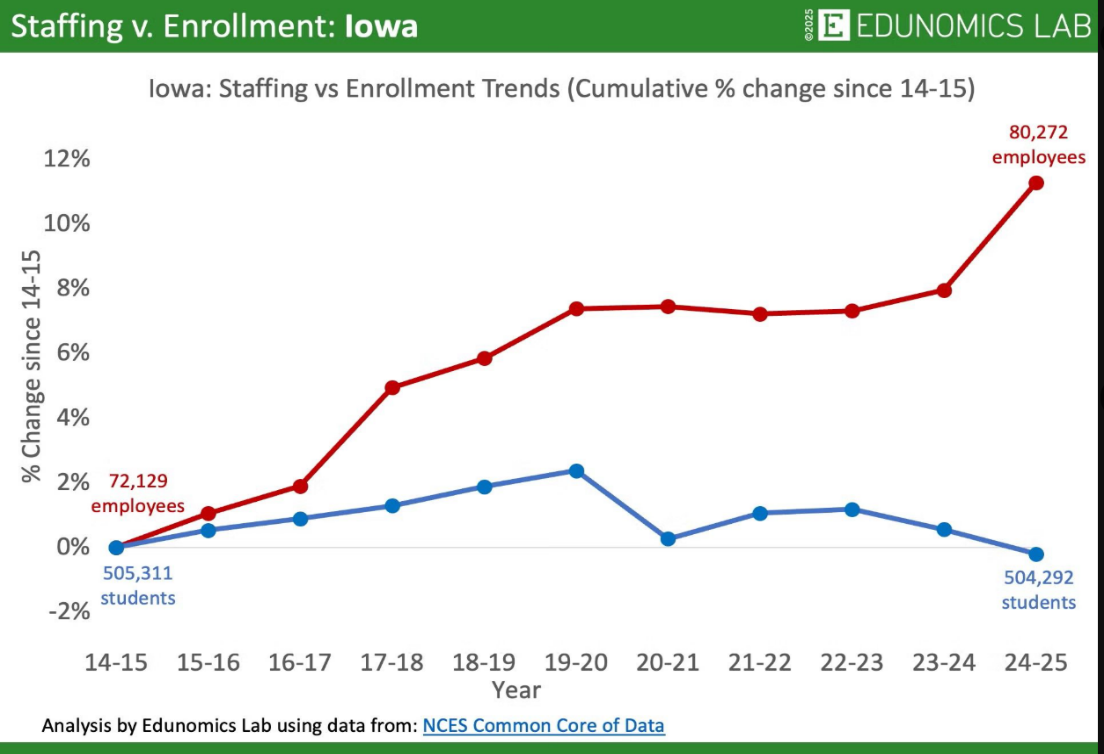
Edunomics has this Iowa chart and similar charts from other states on their website. The number of employees is verified from the NCES Common Core of Data. The PK-12 enrollment numbers were also verified from DE’s enrollment files. KCRG out of Cedar Rapids published a “Fact Check” on Feb. 11, which reported that the school funding “increase is lagging significantly behind inflation - which is also evident through districts like Cedar Rapids and Decorah requesting a 5% increase.”
KCRG examined the categories of school employees using the National Center for Education Statistics data. Their findings include the following:
- The number of FTE teachers rose by just more than 500, with growth for elementary teachers and a slight decline in secondary.
- School administrators increased 265 statewide, from less than 1,800 to just more than 2,000.
- District administrators added 820 people, or an increase of nearly 65% in the ten-year period.
- Para educators jumped by close to 3,600. This role usually involves working with students who are in special education programs, or IEPs. That jump was from about 11,700 to 15,300. (Students with IEPs increased by about 19% - from almost 58,000 to almost 69,000 children.)
- Instructional coordinators increased about 550 to 2,400. That is about 4.5 times the amount in 2014. These staff members, who are sometimes teachers themselves, work with educators to improve programs and curriculum. Iowa saw these numbers skyrocket after the introduction of the Iowa Teacher Leadership and Compensation Program.
- The program was part of a 2013 education reform bill to increase teacher pay and give raises to teachers who take on those leadership responsibilities.
- Paras and instructional coordinators make up almost 5,500 of the 8,000-employee difference from 2014-2015 to 2024-2025.
Additionally, ISFIS staff reviewed the DE’s condition of education K-12 data and statistics staffing data, and found the following:
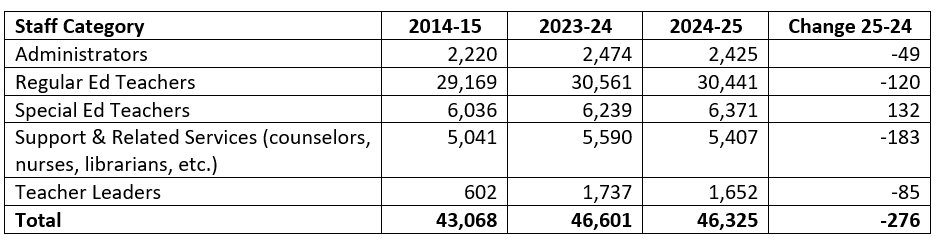
Although staffing numbers have increased over the last ten years, the change from 2024 to 2025 shows a reversal, with decreases in all areas above except for special education teachers.
There are likely many factors at play over this decade, including a global pandemic, hundreds of millions of dollars available to school districts with a directive to recover lost learning from school closures. Some schools offered summer school, tutoring, literacy initiatives and other programs. Rural schools began receiving transportation reimbursement, allowing them to afford district-level staff (curriculum directors, special education directors, etc.) that could now also be funded through operational shared weighting. Increased monitoring, reporting and oversight at state and federal levels, combined with unfunded mandates, also likely contributed to staff increases. Least restrictive environment court rulings requiring students with special education individual education plans to be placed in regular education classrooms and increases in students with disabilities may have driven growth in paraprofessionals and special education teachers.
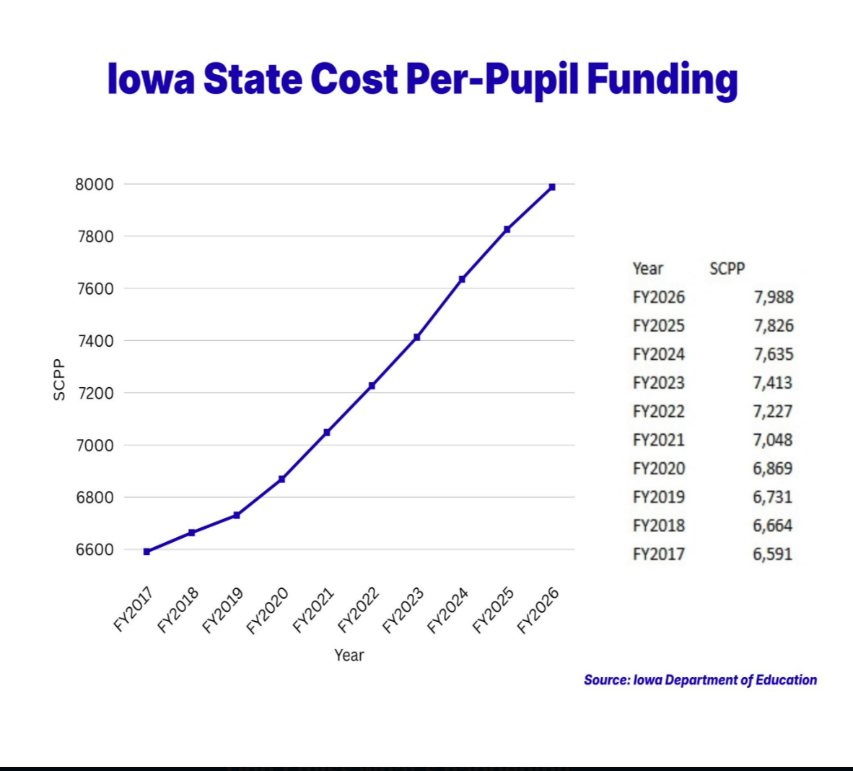
Governor Reynolds also posted a chart showing increases in Iowa State Cost Per-Pupil Funding. The Governor’s post stated, “The purpose of school funding is to educate our students, not to fund an ever-growing administration.”
There are many ways to consider data. ISFIS analysts shared their analysis of the state per pupil costs both over time and controlling for inflation.
The following chart shows the comparison controlling for inflation. The data comes from the state cost per pupil amounts put into the Bureau of Labor Statistics calculator on a School Year basis.
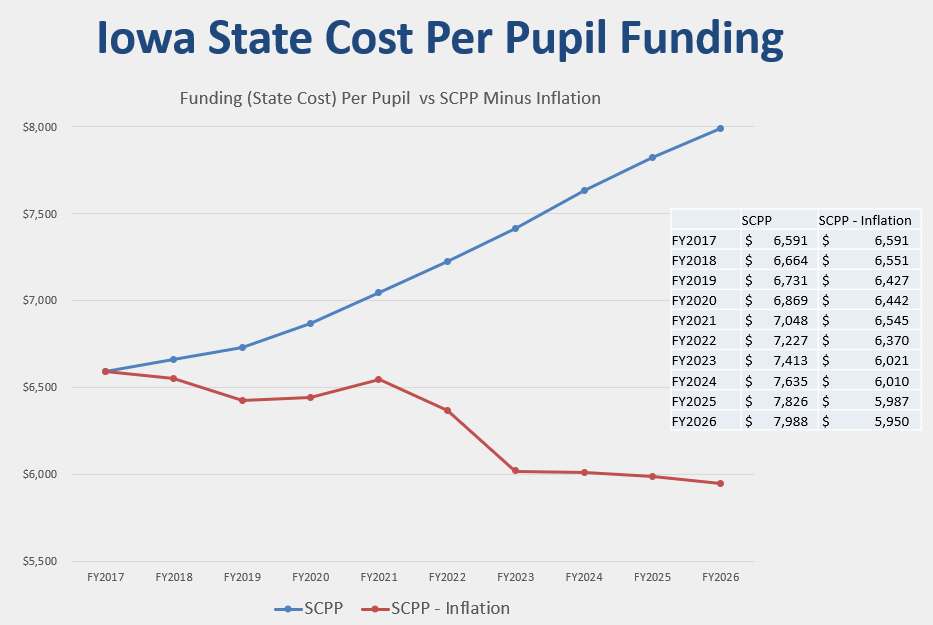
This analysis shows the loss of purchasing power of the state cost per pupil, controlling for inflation, down more than 9% over the decade of the comparison.
Local school leaders are encouraged to look at your district’s history, analyze causes of evident trends, and have a discussion with legislators about student needs and staffing required to meet those needs.
House and Senate Committee Action This Week
These bills, having cleared a committee in their chamber of origin, have already survived the Feb. 20 funnel deadline as they move to their respective calendars. Typically, bills approved by a committee in their chamber of origin receive a new bill number after committee approval.
House Education Committee Approval
- HF 2049 Shared Teacher Functions: makes career and technical education teachers eligible positions for supplementary weighing as shared operational functions. Requires the sharing be for at least 20% of the school year. Passed 23-0; FM: Ingels. Registered as undecided.
- HF 2092 PK Eligibility: expands eligibility and funding for the statewide voluntary preschool program, instead of just four-year-olds, for “young children” defined as four-year-olds and five-year-olds with birthdays before March 1. Applies to the 2027-28 school year. Passed 20-3; FM: Kniff McCulla. Registered as undecided.
- HSB 599 Education Reports: requires the DE to submit annual reports on district progress toward reading and math proficiency. Requires annual reports on the impact on AEAs of the changes to special education services in 2024. Passed 23-0; FM: C Johnson. Registered as undecided.
- HSB 648 Teach Iowa Grants: changes the Teach Iowa Loan Forgiveness grant requirements for eligible teachers. Strikes requirements that the candidate be in the top 25% of the class. Requires 20% of the grants go to Special Education teachers and that 50% go to teachers in rural districts defined as under 1,000 students. Passed 3-0; FM: Behn. Registered as undecided.
- HSB 678 Non-Public School Transportation Appropriation (Error Correction): appropriates an additional $187,000 in FY 2025 for non-public school transportation claims. Requires the DE use the funds to reimburse a district with a reporting error in FY 2025. Passed 23-0; FM: Wheeler. Registered in support.
- HF 2122 School Violence Policies: authorizes teachers to remove students from the classroom who are disorderly (for either violent or nonviolent disruptions). Requires a principal to take disciplinary action if needed and to inform parents. Specifies disciplinary measures. Establishes immunity provisions. Requires schools to adopt policies for dealing with students who disrupt the educational process. Requires schools give teachers who are injured a minimum of five days leave for recovery. An amendment in the committee changed metrics for Iowa School Performance Profiles, allowing suspensions and expulsions for violent or disruptive behavior to contribute positively to the attendance center ranking for safety, culture and climate. 16-7; FM: Gehlbach. Registered as undecided.
- HF 2124 Electronic Data Systems: requires DE to develop standards for the use of an electronic data system by all schools and to take steps to modernize electronic systems for the disbursement of monies. Includes timelines. Amended to clarify that this is not an SIS and does not require districts to purchase a different SIS. This data system is to simplify and standardize reporting, serving as a bridge between LEA data systems and the DE. Specifies that districts own the data and limits the data that can be collected by the DE. Amended and passed 19-4; FM: Gehlbach. With the addition of the amendment, UEN is registered in support.
- HSB 610 Computer Science Graduation Requirement: adds computer science to high school graduation requirements by the 2030-31 school year. Requires DE to publish lists of approved coursework. Includes other related and conforming provisions. Requires teacher preparation courses to include computer science coursework. Includes instruction on artificial intelligence. Includes provisions on endorsements. Allows additional teachers, including career and technical education teachers, to qualify for incentives and teach the computer science classes. Amended and passed 19-4; FM: Ingels. Registered as undecided.
- HSB 646 Antisemitism Reports: requires the State BOE to report every October on incidents of antisemitism that occurred in public schools, community colleges and Regent schools during the past year and on the investigations conducted on the incidents. Requires public schools, the community colleges and the Regents to report every year. Requires the Regents to review policies every year. Amended to conform with the Senate bill, adding a prohibition from employees engaging in antisemitism. Passed 17-6; FM: Bradley. Registered as undecided.
- HSB 679 Sports Non-contact Periods: establishes non-contact periods for high school athletes during which coaches and administrators will not have contact with student athletes and during which no sports happen. Passed 20-3; FM: Wheeler. Registered as undecided.
- HSB 681 School Dress Codes: requires public schools and charter schools to adopt a dress code for K-12 students. Requires appropriate attire that promotes neatness and modesty. Bars specific kinds of clothing. Requires that clothes be clean. Allows school boards to adopt additional rules. Requires the dress code to be posted. Passed 14-9; FM: Larson. Registered as undecided.
- HSB 682 Revoking Teacher Licenses for Public Speech: requires the BOEE to revoke the license of a teacher for publicly celebrating political violence or killings. Specifically cites the killing of Charlie Kirk and makes the bill retroactive to Sept. 2025. Exempts speech that is protected by the 1st Amendment, but states that this kind of speech is not considered protected by the 1st Amendment. Amended and passed 14-9; FM: Stone. Registered as opposed.
- HSB 714 Social Studies Content: makes changes to Social Studies at K-12 and Regents schools to require specific content regarding government, secular and religious ideas, western civilization, the US and Iowa and on other matters (15 pages worth of specific requirements). Prohibits credit for action civics or political activism. Includes reporting. Specifies that this content requirement does not impact student graduation requirements. Passed. FM Boden. Registered as opposed.
Senate Education Committee Approval
- SF 516 School Technology Report: requires DE to convene a task force with the HHS on the cognitive impact of school technology on students and to report by Dec. 2025. Sets membership for the task force. Amended to apply to 2026. Passed 15-0; FM: Taylor. Registered in support.
- SF 2062 Student Protected Speech: prohibits schools from preventing students from engaging in religious, ideological or political speech or from expressing in schoolwork. Requires schools to allow students to wear clothing/jewelry expressing political/religious views. Prohibits schools from discriminating against student clubs for political/religious views. Requires DE to distribute federal guidance on constitutional protections, for schools to share w/employees and provide professional development. Waives school protections against lawsuits and allows students to sue. Passed 15-0; FM: Salmon. Registered opposed.
- SF 2063 Prohibiting DEI Courses: requires the Regents to adopt policies prohibiting state universities from offering courses with DEI curriculum. Amended and Passed 15-0; FM: Salmon. Registered opposed.
- SF 2084 Your Life Iowa Posting: requires schools to post the Your Life Iowa information for students in 7-12 on their websites. Passed 15-0; FM: Taylor. Registered as undecided.
- SF 2170 Community College Sharing Programs: requires students in a district/community college sharing program to use in-person instruction, unless the school superintendent or superintendent’s designee approves online instruction. Approved 15-0; FM: Green. Registered in support.
- SF 2176 HS-CC Courses: allows a school district to require a high school student who fails a community college class to reimburse the school for the cost of the course. Passed 11-4; FM: Green. Registered in support.
- SSB 3095 Antisemitism Reports: requires State BOE to report annually on incidents of antisemitism in public schools, community colleges and Regent schools during the past year and on investigations conducted. Requires public schools, community colleges and Regents to report annually. Requires Regents to annually review policies. Amended to add a prohibition on antisemitic employee behaviors. Passed 14-0-1; FM: Green. Registered as undecided.
Other Committees
House Economic Growth & Technology Committee
- HSB 609 AI/Cyber Security Education: requires the Workforce Development Board to develop an initiative on cyber/AI workplace needs, including K-12 educational needs and university needs. Requires the State BOE to work with the Regents and public schools to work on educational frameworks. Requires the DE to develop a digital educational hub. Registered as undecided.
House Higher Education Committee
- HSB 674 Apprenticeship Programs: Intermediaries: Adds intermediary sponsors for apprenticeships. Makes such sponsors eligible for financial assistance. Apprenticeships: Encourages schools to establish work-based learning programs. Other: Makes changes to the Workforce Board. Makes changes to high-demand job programs and scholarships. Requires the BOEE to limit the qualifications for an applicant for a CTE authorization to 3,000 hours. Registered as undecided.
- HSB 572 DE’s Career Education and Community Colleges: modifies provisions related to career academies, the collective statewide articulation agreement between community colleges and the state board of regents, the district-to-community college sharing or concurrent enrollment program, qualifies summer community college course work as eligible for supplementary weighting, specifies that a community college course that earns college credit satisfies the time requirement for high school credits, and requires a conversation with students for individual career and academic planning. Registered in support.
House State Government Committee
- HSB 578 Public Meeting Notices: requires giving notice to news media who have requested notice for public meetings, and for posting notices about open meetings in a conspicuous place and on a government website. Requires amended agendas to be marked as amended. Passed 22-0; FM: Siegrist. Registered as undecided.
- HSB 627 Election Changes: Div. VI requires school filings to be with the county auditor (commissioner of elections). Registered as undecided.
Senate State Government Committee
- SSB 3075 Public Investment Trusts: allows public funds to be invested in CDs from a credit union. Allows a local government to invest up to 25% of its public funds in a joint investment trust. Requires written acknowledgement of insurance and safety. Prohibits payments to a third party except for certain services. Passed 14-2; FM: Bousselot. Registered in opposition.
- SSB 3078 Election Changes: Requires school filings to be with the county auditor (commissioner of elections). Passed 16-0; FM: Rozenboom. Registered as undecided.
House Ways and Means Committee
- HF 1023 IPERS Protection Changes: Changes the employer/employee contribution split (employer down from 60% to 50%; employee up from 40% to 50%). Benefits: Increases the percentage for IPERS protection occupation members used to calculate additional benefits beyond 22 years of service (from 0.375% and 12% to 0.675% and 20%). Allows early retirement at age 50. Establishes a COLA and eligibility requirements. Amended to strike provisions duplicated in other bills and passed 17-0; FM: Dawson. Registered as undecided.
Subcommittee Meetings of Interest
- SSB 3109 Success Sequence Instruction: requires social studies curriculum to include instruction about a success sequence of behaviors and actions, which is research-based, to instruct students that high school graduation, followed by full-time employment, followed by marriage, all before children, is the best path to success. Also requires research-based instruction that children of divorced parents are more likely to live in poverty and experience law enforcement consequences. The Subcommittee of Evans, Green and Zimmer moved the bill forward to the full Education Committee, 2:1. Registered opposed.
- HSB 677 Teaching Endorsements: requires the BOEE to establish endorsements for instruction related to fine arts, math, science and agriculture. Requires applicants to have a BA degree. The Subcommittee moved the bill forward to the full Education Committee. Registered in support.
- HSB 683 Physical Activity in Schools: requires 30 minutes of physical activity each day in addition to PE for all students in elementary and middle school (grades 1-8). Beginning in 6th grade and through high school, it requires including self-defense in the PE class. For high school, 1/8th unit of PE is required for each semester, 120 minutes a week (current law.) It exempts students in sports or non-school-sponsored activities that match or exceed 120 minutes of physical activity a week. Students can also be excused from the activity requirement if they are in a work-based learning program that requires they leave the school, or if they have an academic schedule conflict or for health reasons. The bill also requires that all students in grades 9-12 participate in at least one co-curricular or extracurricular activity as a condition of graduation. The Subcommittee moved the bill forward to the full Education Committee. Registered opposed.
- SF 2132 SRO Benefits: would allow a retired police officer or other law enforcement officers to continue to receive their retirement, after fulfilling a 30-day retirement period as a bona fide retirement, to be reemployed by law enforcement to work as a SRO in a school. The Subcommittee moved the bill forward to the full Education Committee. Registered in support.
- HSB 676 Charter Schools by the Governor: Most of the bill’s language removes innovation zone schools from Chapter 256F. Two sections apply to School Board Authorized Charter schools:
- Sec. 32 requires a charter school chartered by a school board to include a performance framework with the application that is used by the state BOE to evaluate the charter school.
- Sec. 36 allows a contract term of 5 years for charter schools authored by the school board, beginning with any new applications or reauthorizations of existing charter schools under this model. Also requires the contract between the school board and the state BOE to include an operating agreement and the performance framework mentioned above.
- Sale of Property: Sec. 46 Strikes IC 297.24 sub 3 paragraph d. Removes the requirement of a school board selling property to sell it to an innovation zone school if that is the lowest bidder.
- Division II Funding (Opposed to this Division):
- Requires the TSS State Cost per Pupil be paid by the resident district to the charter school. Rather than sending public school funds to charter schools, we think the state should fund them directly from the state. Either set a state payment from an appropriation or deduct the amount required from state foundation aid apportioned to all school districts without impacting spending authority (modeled on the costs of out-of-state placement for special education from last year).
- Media and Education Services: Requires that media and education service funding be deducted by DOM and paid to AEAs. Requires AEAs to provide media and education services to charter schools.
- Concurrent Enrollment: Allows charter school students to access community college courses through public schools. (presumably, public schools would count the students and generate supplementary weighting, but that is usually not sufficient to cover the community college course).
Subcommittee approved the bill 2:1 – moves to the full House Education Committee. Registered in opposition.
- SF 2116 Open Enrolled Truants: requires students identified for chronic absenteeism interventions, including participation in a school engagement meeting, is not allowed to open enroll out of the district until the attendance and truancy concerns are corrected. Notwithstands that provision, if the receiving district approves the open enrollment. Removes the exemption from the March 1 open enrollment application deadline applying to online academies (however, the floor manager said that provision was not supposed to be included and would be removed via amendment in the Committee). Subcommittee approved the bill, moving it to the full Senate Education Committee. Registered in support.
- SF 176 Open Enrolled Extracurriculars: modifies the conditions under which a student enrolled in an online academy may participate in resident district extracurricular activities to apply only if the district to which the student is open enrolled in the online program does not offer such cocurricular or extracurricular activities. Subcommittee approved the bill, moving it to the full House Education Committee. Registered in support.
- SF 2200 School Email Security: establishes a mandatory, enterprise-level cybersecurity standard for school district email systems, requiring AI-driven threat detection, impersonation safeguards, data loss prevention, encryption, and compliance reporting by Jan. 1, 2027. The Subcommittee discussed appropriate funding mechanisms to avoid an unfunded mandate. Subcommittee approved the bill, moving it to the full Senate Education Committee. Registered as undecided.
- HF 2077 School Weapons Carry Insurance: allows school boards to use SAVE to pay for costs of insurance related to employees authorized to carry weapons on school grounds. The Subcommittee did not move the bill forward. Registered in opposition.
- HF 2218 Recording Special Education Classes: requires school districts to install cameras in classrooms where special education students are enrolled. Subcommittee approved the bill, moving it to the full House Education Committee. Registered in opposition.
- HF 2029 School Districts in State Health Insurance Pool: allows a public school district to apply to the Iowa Department of Administrative Services (DAS) for coverage under the state health insurance plan of all of the public school district’s nonstate public employees. Requires school districts to pay premium rates equal to the total premium rate paid by the state, inclusive of any premiums paid by state employees for the particular state health care product offered by the state plan. Allows DAS to charge a fee for administration. Allows school districts to require employees to pay a share of the premium. Is effective July 1, 2027. Subcommittee approved the bill, moving it to the full House State Government Committee. Registered in support.
- HSB 680 Community Preschool: allows DE to approve community-based providers directly into the SVPP without working with a school district. Expressed concern with the disparate funding mechanisms, that community-based providers are funded for new students in the year in which the program is authorized, whereas school districts are funded based on the prior enrollment count, without providing funding for new sections or program expansion. Subcommittee approved the bill, moving it to the full House Education Committee. Registered as opposed.
- HF 2034 Open Enrolled Sports: changes the existing 90-school-day waiting period for students open enrolling into a district before they can participate in varsity athletics to a 140-calendar-day waiting period. This was authored to create parity for districts with 4-day school weeks. Subcommittee approved the bill, moving it to the full House Education Committee. Registered in support.
- HSB 717 School Efficiency and Deregulation Matters: provides regulatory relief and flexibility to school districts. Removes requirements for public hearings related to instructional support levy, deposits of funds, and flexibility account expenditures, adds TSS categorical balances as eligible to transfer to flexibility accounts, reinstates the March 1 open enrollment deadline for open enrollment into an online academy. Subcommittee approved the bill, moving it to the full House Education Committee. UEN is in support.
Bills in the Education Committees
There are two places to find lists, links and descriptions of bills in each of the chamber’s Education Committees:
Senate Education Committee
- Bills sponsored by individual legislators or bills passed by the other chamber, are found here: https://www.legis.iowa.gov/committees/committeeBills?committee=327&GA=91
- Study bills sponsored by the DE, the Governor or the Chair of the Committee, are found here: https://www.legis.iowa.gov/committees/committeeStudyBills?committee=327&GA=91
House Education Committee
- Bills sponsored by individual legislators or bills passed by the other chamber, are found here: https://www.legis.iowa.gov/committees/committeeBills?committee=686&GA=91
- Study bills sponsored by the DE, the Governor or the Chair of the Committee, are found here: https://www.legis.iowa.gov/committees/committeeStudyBills?committee=686&GA=91
Advocacy Actions This Week
Adequate School Funding: Contact Representatives regarding SSA. Members of the House Appropriations Committee will soon consider SF 2201. See the Committee members and their email addresses on the Committee’s legislative page here: https://www.legis.iowa.gov/committees/committee?ga=91&groupID=695
The Governor’s recommendation of 2.0% falls short of inflation (as has every SSA increase over the last five years). The Senate’s 1.75% is even worse. The teacher salary investment last year was a really good start, but SSA has to keep pace, or our staff and programs for students will be compromised. See the UEN Issue Brief for additional information. The House has scheduled a subcommittee for 11:30 on Monday to consider SF 2201, the Senate’s proposal with 1.75%. Additional Supports:
- Download the UEN 2026 Adequate School Funding Issue Brief, providing education funding history, comparing total Iowa education expenditures per pupil, which most recently ranked our state as 35th in the nation, now spending over $2,700 less per student than the national average, and including some talking points to help you advocate with your legislators. UEN’s Legislative Priority supports an SSA rate that at least matches the inflation rate schools are experiencing.
- The REC sets a revenue growth estimate for FY 2027 of 4.2%. Shouldn’t schools benefit from the general fund recovery?
- With a statewide enrollment decline of 7,336 students, the cost of SSA to the state is lower than it would normally be. The state could fund a 4% increase at a cost of $132 million (lower than last year’s increase of $134 million). Higher SSA of 4% would leave fewer districts on the budget guarantee and lower budget guarantee property taxes to 25% of those estimated in the Governor’s 2% recommendation. The higher SSA would also result is less special education deficits or English-Learner requests for modified supplemental amount (MSA) from the School Budget Review Committee (SBRC).
- The ISFIS New Authority Calculator allows users to set the SSA rate and calculate the impact across all districts for FY 2027 on your regular program (not including special education or other supplementary weightings). Enter the SSA percentage increase to compare to the new money you’d receive if the SSA rate was higher than the Governor’s Recommendation of 2.0% or the Senate’s 1.75%. Check out the new tab to determine the impact of proposals on your TSS and other per pupil categoricals and media and education services. What would that additional authority provide for students? What happens if your school experiences a few more years of 2% or lower?
Property Tax Relief: No committee or subcommittee action this week, but keep in contact with legislators about school district concerns and questions (or even kudos for some things that you like). Encourage legislators to get fiscal estimates from LSA and DOM before proceeding with big system changes. The property tax system is complicated. Multiple changes to all three components of the system are very hard to predict.
- The Senate’s proposal, in particular, significantly changes or limits all three components: Valuation, Rates and Total Levy (dollars collected).
- The Governor’s version is more modest, but still accelerates SAVE funds within a very short time frame, negatively impacting resources available for school infrastructure, safety and equipment. This proposal removes an estimated $170 million annually from school infrastructure, technology, safety, equipment, buses and construction in four years. Reach out to the experts at Piper Sandler to discuss the point at which your district may be at risk of defaulting on bonds if SAVE is reduced based on the Governor’s proposal. See Piper Sandler’s SAVE Bond Default Risk Calculator
- There is already significant voter involvement in SAVE:
- Voters approve a district RPS, which must include bonding to authorize it.
- Many districts have facility planning and infrastructure committees that involve local citizens, taxpayers, and community leaders.
- Public hearings are held on SAVE bonding decisions.
- A reverse referendum is an opportunity for taxpayers if used for athletic facilities.
- Many districts choose to move slowly, bonding for just a year or two at a time and improving facility safety and upgrades along the way. Having to hold special elections every other year would be cost-prohibitive.
- Delays increase costs as revenue growth doesn't keep pace with construction inflation.
- Districts would be more inclined to use property tax bonds, which get a better interest rate if the SAVE process was changed, which doesn't align with the intention of this bill.
Protect schools from property tax reductions and limiting policies that restrict revenue, since schools are already primarily budget-limited and enrollment-driven under the foundation formula.
See the UEN Property Tax Reform 2026 Issue Brief for additional talking points and items to discuss with your legislators. See the ISFIS Property Tax Comparison Side-by-Side, which compares and contrasts the ideas in all three.
Quality Preschool and Teacher Shortages: In every communication, find a way to mention Quality Preschool and Teacher (especially special education) and other Staff Shortages. Find Issue Briefs and other resources on the UEN Website to find talking points or as resources to share when you meet with policymakers.
Connecting with Legislators: To call and leave a message at the Statehouse during the legislative session, the House switchboard operator number is 515.281.3221 and the Senate switchboard operator number is 515.281.3371. You can ask if they are available or leave a message for them to call you back. You can also ask them for the best way to contact them during the session. They may prefer email, text message, or a phone call, based on their personal preferences.
Find out who your legislators are through the interactive map or address search posted on the Legislative Website here: https://www.legis.iowa.gov/legislators/find
Other UEN Advocacy Resources:
Check out the UEN Website at www.uen-ia.org to find Issue Briefs, these UEN Weekly Update Reports and Videos, UEN Calls to Action when immediate advocacy action is required, testimony presented to the State Board of Education, the DE or any legislative committee or public hearing, and links to fiscal information that may inform your work. The latest legislative actions from the Statehouse will be posted at: www.uen-ia.org/blogs-list. The 2026 UEN Advocacy Handbook will be available and posted soon at www.uen-ia.org/advocacy-handbook.
Contact Us
Margaret Buckton
UEN Executive Director
margaret@iowaschoolfinance.com
515.201.3755 Cell
Thanks to our 2025-26 UEN Corporate Sponsors:
Special thank you to your UEN Corporate Sponsors for their support of UEN programs and services. Find information about how these organizations may help your district on the Corporate Sponsor page of the UEN website at www.uen-ia.org/uen-sponsors.
- 10Fold Architecture + Engineering - www.10foldarchitecture.com
- INVISION Architecture - www.invisionarch.com
- Solution Tree - www.solutiontree.com/st-states/iowa