Capitol Update - April 9, 2026
UEN Legislative Update
April 9, 2026
(Download this week's printable UEN Legislative Written Report)
This UEN Weekly Report from the 2026 Legislative Session includes:
- MAHA Bill Amended in the Senate – It’s Much Better
- Student Behavior Amended in the House – It’s Better
- Property Tax Bill Amended in the Senate – It’s a Little Better
- Budget Bills See Action
- Floor Action on Other Bills This Week in Both Chambers
- Bills Still in the Mix of Interest to School Leaders
- Advocacy Actions for the Week
- Advocacy Resources
Session Timeline
The Session has just under three weeks left before the 100th day, April 21, when per diem reimbursements for Legislators expire. Before adjourning, the House and Senate will have to pass a budget (appropriations bills), decide whether to compromise on property tax reform, determine whether there is common ground on pipeline eminent domain legislation, and finish up the hundreds of policy bills waiting for their attention. With the General Election in November, legislators are further motivated to finish up so they can start campaigning. See the Session Timeline here: https://www.legis.iowa.gov/docs/publications/SESTT/current.pdf
MAHA Bill Amended in the Senate – It’s Much Better
Senator Warme, Floor Manager of the bill, offered a strike-after amendment, H-8335 to HF 2676. The provisions impacting schools, as amended, include:
Div. V School Foods and Beverages: Prohibits charter schools, accredited nonpublic schools, and public schools from serving breakfast or lunch meals that include eight different ingredients. Excludes food and beverages received as part of a direct delivery from the “Foods in Schools” program of the U.S. Dept. of Agriculture. Effective July 1, 2027.
Div. VI Ephedrine Delivery Systems: Changes IC§135.185 and IC§280.16 provisions from requiring ephedrine auto-injector to ephedrine delivery systems (almost 40 times in the Code). Defines the delivery system to include epinephrine auto-injectors and epinephrine nasal sprays. School Board policies will need to be updated accordingly.
Div. VIII Student Instructional Technology Standards: Requires charter schools and public schools to limit screen time to no more than 60 minutes a day for K-5 students. Defines digital instruction to mean lessons, assignments, assessments, or instructional activities delivered through instructional technology.
- Defines instructional technology to include laptop, tablet, computer, smart device, software platform, or other similar device or platform used for student learning.
- Exceptions: Excludes several things from the 60-minute limit, including use required for an IEP, or 504 plan, or assistive or adaptive technology used to provide a student access to instruction or to accommodate differing student abilities, teacher-directed demonstrations using a projector, smartboard, or similar display device when students are not individually operating a device, state assessments, screening, progress monitoring, and local diagnostic assessments that require the use of a one-to-one device, and dedicated computer science and technology curriculum. Also excludes the application of the limit to students enrolled in an online learning program.
- Board Policy: Requires the school board to have a written technology policy for K-5, including: 1) district’s daily digital instruction limits, 2) notice of a parent’s right to request additional reductions in their child’s digital instruction, 3) a statement that instructional technology shall support and not supplant foundational learning and 4) a prohibition on the use of digital devices during recess. Requires the policy to be published on each elementary school’s website.
- Checklist for One-to-One Initiative: Requires, prior to adopting or renewing a one-to-one digital device program for any grade level, the school board must complete a technology adoption checklist that documents considerations of all of the following: 1) the instructional purpose of the device, 2) age appropriateness of the device and associated software, 3) content-filtering limitations and the district’s capacity to mitigate those limitations, and 4) whether student data is collected, stored, or shared, and the nature of such data practices. Requires the Board to retain the checklist and make it available to the DE upon request for audit or compliance purposes.
- Requires DE to convene a working group to study the impact of technology on cognitive learning. Requires the group to examine research on the impact of school-provided technology on students' cognitive function and academic performance in grades 6-12. Defines “school-provided technology” to include laptops, online learning management systems, and classroom slide show presentations. The working group is required to report findings/recommendations by December 31, 2026, including best practices for the use of school-provided technology in educational contexts, with a focus on ways to mitigate potential effects on attention span, mental concentration, and learning ability among 6-12 grade students.
The bill, as amended, was approved 89 to 4, sending it back to the House. UEN was registered in opposition prior to the Amendment. We have changed our registration to undecided.
Student Behavior Amended in the House – It’s Better
Rep. Wheeler, Floor Manager of SF 2428 in the House, offered a strike-after amendment S-5166, which improved the bill. Details of the Amendment follow:
Sec. 1: Training Program and Materials: Requires DE to develop and distribute training program and materials for Individual Education Plan (IEP) team members including information on Least Restrictive Environment (LRE).
Sec. 2: Accreditation and Reporting: Requires DE’s monitoring and enforcement of accreditation to consider timeliness and accuracy of information provided by school districts and nonpublic schools, including potential under-reporting or late reporting of data related to school discipline and school safety, necessary to monitor and implement provisions of IC 280.
Sec. 3: Requires DE to establish a special education pilot, one rural (definitive place) and one urban (>7,000 students), which districts must agree to participate in, and which must either be funded with an appropriation or self-sustained by the district. Requires DE to consult with the participating districts in determining the course of study and instructional facilities. Allows parents to opt their students out of the program. Requires participants to submit an annual report to the DE, which is then compiled and submitted to the General Assembly. Defines an eligible special education student as a student whose emotional, social, or behavioral needs interfere with the student’s ability to be successful in the regular education environment, even with the use of supplementary aids and services.
Sec. 4 & 5: Requires charter schools to comply with IC 279.65B relating to classroom disruptions and student behavior.
Sec. 6: Requires school board policies on student behavior be consistent with IC § 256B and administrative rules, Federal IDEA 20 U.S.C. §1400, Federal Rehabilitation Act of 1973, as amended in 29 U.S.C. §701, and this new IC § 279.65B Discipline of students who cause violent or nonviolent disruptions.
Sec. 7: Classroom Removal Provisions:
- Defines “nonviolent disruption” including but not limited to classroom instruction that is a result of any of the following: Disorderly conduct, Abusive or profane language, Bullying as defined under section 280.28, and Repeatedly disruptive behavior. Defines “violent disruption” including but not limited to a disruption to classroom instruction that is a result of threat of violence or an incident of violence that results in: Injury, Property damage, Assault, as defined under section 708.1.
- Removal of student from classroom (nonviolent behavior). Allows a teacher to remove a student who causes a nonviolent disruption and place the student under the principal's supervision for at least 30 minutes, as determined by the principal (or the principal’s designee). If the student is in Kindergarten through Grade 5, the teacher and principal must meet to discuss the student's readmission before the student returns. If the students are in grades 6-12, the bill prohibits readmission until after the teacher and principal meet to discuss, and further requires the earliest readmission to the teacher’s classroom in the immediately subsequent school day. Requires the principal to inform the teacher of disciplinary actions taken against the student as soon as is reasonably possible after the student’s removal. Requires the student to make up any work missed while at the principal’s office. If the student is removed twice in a semester (or calendar equivalent), requires the principal to convene a meeting of the teacher, principal, counselor, parent or guardian, and student to discuss the nonviolent disruptions and establish a behavior plan and course of discipline, which may include an alternative placement, such as a therapeutic classroom when appropriate.
- Removal of student from classroom (violent behavior): Requires a teacher to remove a student who causes a violent disruption and place the student under the principal’s supervision. If the student is in kindergarten through grade five, the student, the teacher, and the principal must meet to discuss the student's readmission before the student returns. If the student in in Grades 6-12, prohibits readmission until after the teacher and principal meet to discuss and allows the earliest readmission to the teacher’s classroom in the immediately subsequent school day.
- Return to Classroom: Notwithstanding any policy adopted by the oversight review committee, prohibits readmission if: 1) The removal was due to violence including assault on the teacher, and 2) The teacher does not consent to allowing the student to return.
- Discipline/Consequences: If the principal determines that disciplinary action should be taken, then the principal must take the action and provide written (and if possible, electronic notice) to parents. If the student is removed 2X or more in a semester, then the principal shall discipline the student with either in-school or out-of-school suspension or recommend to the superintendent that the student be placed in an alternative learning environment approved by the superintendent. If the student’s violent actions are severe/pervasive and the teacher requests, the principal shall impose the maximum amount of punishment applicable, per board policy, including placing the student in an alternative learning environment approved by the superintendent.
- Board Policy and Oversight Review Committee: Specifies that the Board shall require each attendance center within the district to create an oversight review committee responsible for developing a policy, consistent with this code section, that establishes when a student removed from the classroom for nonviolent or violent behavior may be readmitted. Requires the Committee to have two teachers selected by teachers in the school and one administrative employee, mental health or behavior interventionist, selected by the principal. Allows the Committee to issue recommendations related to a student’s return to the classroom (due to nonviolent removal).
- Students with IEPs: Requires the IEP Team to meet immediately subsequent to the student’s exclusion from classroom. Specifies that the meeting must include: the teacher who removed the student; any other teachers who provide classroom instruction to the student; and any other non-licensed employee (para, bus driver, etc.) who was directly involved in the student’s conduct. If an employee is unable to participate in the IEP Team meeting, the classroom teacher or another employee shall review the minutes and provide written notice to the IEP Team that they have read them. During the meeting, the IEP Team is required to consider the following: 1) Appropriateness of the current educational programming in the IEP, 2) Whether adjustments need to be made to address behaviors, 3) Whether current placement or an alternative would best provide FAPE (Free and Appropriate Education), 4) What accommodations, modification and adaptations are required for the student to be successful in the general education setting and 5) what supports are needed to assist the teacher and others in providing those accommodations, etc., and whether it’s possible for the school districts to provide those accommodations, etc., 6) Whether and to what extent providing the student’s special education services in the general education classroom will impact the student and other students in the classroom. Requires the team to prepare minutes of the IEP Team meeting to share with any participants who could not attend. Requires that if a student was removed 5 or more times from the classroom within any 15-consecutive school day period, the IEP team must meet to discuss behavior.
- Students with IEP: Requires the Board to grant full paid leave of 3 days if a teacher is injured due to a violent disruption, but allows longer if a doctor’s note indicates more time is needed. Requires the principal to make trauma support available to students, teachers and other employees to address immediate trauma associated with a violent disruption is requested by the teacher (but still requires parent consent before mental health services can be provided to a student) and defines principal duties. Specifies that this section shall not be construed to infringe on student rights under federal law (IDEA, FERPA, ADA), or supersede any federal law, rule or regulation.
Sec. 8: Teacher authority to request IEP Team Meeting – gives teachers authority to request an IEP Team meeting, at any time, in writing. Allows the principal to deny the request, but must provide the denial to the teacher in writing and describe why applicable federal law does not require the team to meet.
Sec. 9: IEPs and 504 Requirements: Requires school boards to ensure that all school employees responsible for implementation of the IEP (regular education, special education and any other service providers) have access to and read the IEP. Requires that all teachers and providers be informed of their responsibilities related to the IEP and any specific modifications, accommodations, and supports that must be provided per the IEP.
Requires regular education teachers to provide written notice to the special education teacher on the student’s IEP team that they have read the IEP. Requires the came for 504 plans. Requires at least one para to attend IEP team meetings. If practical, requires the meeting take place during normal business hours. Requires school boards to provide training to all team members about Least Restrictive Environment (LRE) based on the DE’s program and materials.
Sec. 10 PD Plans: Requires the school district to include in the districts’ professional development plan, training about a Free and Appropriate Public Education (FAPE), the identification of students with disabilities, teacher responsibilities for IEPs, and LRE.
Sec. 11 Unfunded Mandate: States that this bill is not subject to the unfunded mandate law since the state pays districts state aid.
Corrections: We would suggest the following amendments if changes are going to be made: 1) Tighten the definition of assault on page 5, line 26 (the reference to IC 708.1 includes intent to injure or frighten, in addition to an injury, which is very hard to determine, especially with younger children). We would suggest that the level of assault in order to be permanently removed from a teacher’s classroom would be aggressive enough to show evidence of physical or mental injury. 2) specify that the Notwithstanding any policy language on page 7, lines 18-21, not apply if there is a federal law that requires the student to return to the classroom. 3) When the principal is required to impose the maximum amount of punishments applicable to such conduct as provided in the policies adopted by the school board, in should say on page 8, line 12, after the maximum amount of punishment, under the authority of the principal. 4) Strike page 10, lines 26-29, regarding IEP team meeting after 5th removal within 15 consecutive school days. This language seems unnecessary and duplicative of language in this bill and federal law.
The bill was amended and approved in the House, 89 to 4. UEN is registered as undecided. We appreciate the progress. It goes back to the Senate with S-5166 attached for the Senate to consider. The Senate’s options are to move to concur with the House’s Amendment and vote yes (agree) and send it to the Governor, move to concur with the House’s Amendment and vote no (refuse) sending it back to the House, or amend the House’s Amendment (second-degree Amendment) and return it to the House.
Property Tax Proposal in The Senate: It’s a little Better
The Senate amended the Senate Ways and Means Property Tax Overhaul bill, SF 2472, on Wednesday of this week. The amendments were extensive and we are still analyzing the changes, but at first glance, as amended, the bill includes the following provisions that impact school districts:
- Additional Levy Property Tax Relief: Beginning July 1, 2027, the foundation level threshold is 100%, with the state picking up the cost of the additional levy.
- Management Fund: requires SBRC to review and make recommendations on limitations for management fund expenditures and ending balances, by February 1, 2028. Limits management fund levying authority, based on the average of the prior three years’ expenditures, to not exceed 180% beginning July 1, 2028, scaling down to 165% by July 1, 2031.
- Lowers PPEL and Debt Levy rates to 70% of the existing rate. Includes some provisions to hold districts harmless for obligations in both areas. Also states that the levy rate limitations shall not apply to the payment of general obligation bonds approved for issuance at an election held on or before November 4, 2025, that are sold on or after May 1, 2026.
- Allows local governments to post property tax statements on their websites by March 15.
- TIF Changes: Excludes taxes assessed on new data centers and web search portal businesses to be exempt from TIF diversion, beginning July 1, 2027. Allows school boards to provide revenue to a city for an urban renewal project, but does not allow the school district to seek additional spending authority for that amount.
- Unspent Authorized Budget (UAB) Limitations and On-time Modified Supplemental Amount (MSA): Requires, beginning on or after July 1, 2026, a school districts’ actual unspent balance from the preceding year used to calculate the authorized budget under shall not exceed 35% of the school district’s prior year expenditures unless a greater amount is authorized by SBRC.
- MSA for Growing Enrollment (On-Time Funding): Fixes the on-time funding calculation to reflect the new January second count date. Allows the SBRC (but does not require the Committee) to approve a school board’s request for on-time MSA.
- Board Policies on UAB: Requires school boards to have a policy defining a targeted range and maximum percentage of UAB. Requires the policy to establish the range and maximum with the intent to equalize educational opportunity, provide a good education for all children in the school district, provide property tax relief, decrease the percentage of school costs paid from property taxes and to provide reasonable control of school costs. (These are the same principles that are required for SBRC action.) Requires annual board review of the policy, reflected in the minutes. This provision is effective on enactment.
The bill was approved by the Senate, 41 to 4, sending it to the House. Negotiations are likely to continue behind the scenes until the House, Senate and Governor either come to an agreement or agree to disagree. UEN is registered as undecided
Action on State Budget
This chart from the IALNS Newsletter, April 8, shows progress on budget bills, primarily through Wednesday’s Senate Appropriations Committee. The Committee approved seven of the Governor’s Budget bills, now on the Senate Calendar. They will likely amend these bills with the Senate’s budget ideas, but may wait until the House and Senate agree on budget targets before taking further action.
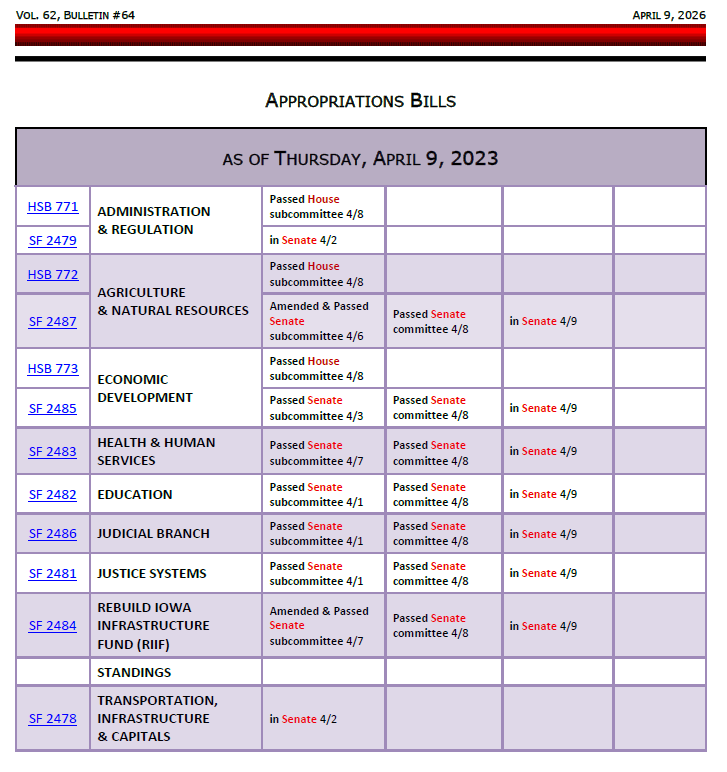
The House held subcommittee hearings on two budget bills, advancing them to the full House Appropriations Committee. See last week’s report for details of the Education Appropriations Bills, now numbered as SF 2482.
Floor Action in Both Chambers
- SF 2286 Joint Investment Trust Limitations: The Senate amended and approved this bill which would limit school districts’ ability to generate meaningful interest rates on liquid cash. The Amendment slightly improved the bill, including the elimination of the penalty and providing 30 days to cure if a local government’s deposits exceed the new 25% limitation. The bill is still bad for schools. Districts are earning much better interest rates than those available for liquid deposits at many local banks. Some local banks cannot cover school deposits under their current insurance coverage. The bill was approved by the Senate, 32 to 13, sending it over to the House. UEN is opposed.
- HF 2752 Teach Iowa Scholar Grants: Eliminates the eligibility requirement that applicants to the Teach Iowa Scholar Program be in the top 25% academically of students exiting a teacher preparation program. Requires beginning in FY 2027:
- 20.00% must be awarded to eligible classroom teachers who provide special education instruction.
- 50.00% must be awarded to eligible classroom teachers employed by a rural school district with a certified enrollment of fewer than 1,000 students.
- The bill was amended to specify that the above criteria are not duplicated (a participation could only count as either special education or rural).
The bill, as amended, was approved by the House, 91:1 and sent to the Senate. UEN is registered as undecided.
- SF 2331 Striking Religious Exclusions: Mandates schools to have 28E agreements with community-based PK providers if requested. Prohibits limits on the number of students who can enroll in the community-provider PK programs. Limits the authority to regulate the standards for admission or for instruction as a condition of receiving aid. The bill was amended to require voluntary PK providers to comply with program standards (including certified teachers, at least 10 hours of instruction weekly, background checks, and quality preschool program standards). UEN requested this Amendment. The bill also strikes language and removes exclusions based on religious content for aid for textbooks, tuition and child development. The House passed the bill as amended 65-25, sending it back to the Senate. Although we appreciate the standards amendment, UEN is still opposed.
- HF 2755 Federal Tuition Tax Credit Program: Requires the Governor to elect for the state to participate in the federal tax credit program for organizations that grant scholarships to private K-12 schools. The House passed the bill 89-3, sending it to the Senate. UEN is undecided.
- SF 2219 FFA/4-H Absences: Requires the boards/directors for schools (public, private and charter) to adopt policies exempting school absences for 4-H/FFA activities. Requires the student to be allowed to make up missed work. The bill was amended to instead require public and private schools to have policies allowing excused absences for school-sponsored activities and allowing students to make up work. The House passed the bill as amended 85-8; sending it back to the Senate. UEN is undecided.
- HF 2591 Open Enrolled Sports: Increases the period for ineligibility for an open-enrolled student to participate in sports from 90 school days to 140 calendar days. The bill is effective beginning August 2026. The House amended the bill to allow 8th graders to compete in high school sports. Allows emergency rules. The bill was passed as amended 92-0, sending it back to the Senate. UEN was originally supportive of the calendar change, but we have concerns about 8th graders in varsity sports.
- SF 140 School Satellite Voting: Prohibits locating a satellite voting station at a school if the ballot includes a vote on school bonds or school levies. Requires the auditor to obscure any published material relating to a ballot measure from the view of voters at a voting site. The Senate passed the bill 33-13 (3/17/25), and the House passed it 63-29; sending it to the Governor. UEN is opposed.
Bills Still in the Mix of Interest to School Leaders
- MAHA HF 2676 with Senate Amendment back in the House
- Charters in Both Chambers SF 2425 is on the Senate Calendar, SF 2406 (same place) and HF 2754 is on the House Appropriations Calendar.
- Student Behavior Bill in Senate SF 2428
- ISJIT/Banking SF 2286 in the House (HF 2592)
- SF 2299 Payback and SF 2320 Presumptive in-person Concurrent Enrollment Changes (Passed Senate, on House Calendar)
- PK young children (5-year-olds) HF 2493 (on Senate Calendar)
- SF 2005 CTE teachers and Operational sharing (attached to HF 2492 on Senate Calendar)
- SF 2220 TAG and Accelerated Learning – in Senate with H-5132 delayed implementation and local determination of readiness on the Senate Calendar
- SF 2482 Education Appropriations on Senate Calendar (look for House to add $7 million for paras to this or standings)
- ESA Categorical and TSS Flex: SF 2144 and HF 2684 Sens. Shipley and Evans are working on a vehicle to include this priority, likely in an appropriations bill.
- U.S. Government Requirements: add Civics and US Government to 7th and 8th Grade. Over-the-top social studies standards from the House failed to advance in the Senate. HF 2244 is attached to SF 2413 on the Senate Calendar. House delays the mandate until July 1, 2028.
- Endorsements SF 2221 and HF 2724: alternative endorsements for fine arts, math, and science teachers. The House version includes Strat II Special Education and activities administrator authorization and is on the Senate Calendar.
Advocacy Actions This Week
As Session begins to wind down, stay close to your email inbox and watch for any last-minute calls to action. Advocacy actions this weekend and into next week include:
- Thank Senators for the Amendment to the MAHA bill in the Senate. Ask Representatives to concur with the Amendment.
- Thank Representatives for the Amendment to the Student Behavior bill. Although we still have a few issues (see at the end of the article on Student Behavior above), it’s better.
- Ask Representatives to just say NO to the ISJIT bill.
- Ask everyone to hit pause on Charter Schools legislation: expansion is happening at a record clip without these changes.
Connecting with Legislators: To call and leave a message at the Statehouse during the legislative session, the House switchboard operator number is 515.281.3221 and the Senate switchboard operator number is 515.281.3371. You can ask if they are available or leave a message for them to call you back. You can also ask them for the best way to contact them during the session. They may prefer email, text message, or a phone call, based on their personal preferences.
Find out who your legislators are through the interactive map or address search posted on the Legislative Website here: https://www.legis.iowa.gov/legislators/find
Secretary of State’s List of Primary Candidates: Iowa Secretary of State, Paul Pate, has posted the final list of candidates for the June primary. Check it out, see who is running in your area. Contact information is included. Access that and save it now, so you can contact state officials at their home address or phone. Party conventions may still nominate candidates to run if there are no primary winners for some seats, so the list of general election candidates will eventually grow. See the list on the SOS website here. Reach out to all candidates, regardless of party, and encourage support for public education, including adequate funding and local flexibility to best meet students' needs.
Other UEN Advocacy Resources:
Check out the UEN Website at www.uen-ia.org to find Issue Briefs, these UEN Weekly Update Reports and Videos, UEN Calls to Action when immediate advocacy action is required, testimony presented to the State Board of Education, the DE or any legislative committee or public hearing, and links to fiscal information that may inform your work. The latest legislative actions from the Statehouse will be posted at: www.uen-ia.org/blogs-list. Also, find the 2026 UEN Advocacy Handbook posted at www.uen-ia.org/advocacy-handbook.
Contact Us
Margaret Buckton
UEN Executive Director
margaret@iowaschoolfinance.com
515.201.3755 Cell
Thanks to our 2025-26 UEN Corporate Sponsors:
Special thank you to your UEN Corporate Sponsors for their support of UEN programs and services. Find information about how these organizations may help your district on the Corporate Sponsor page of the UEN website at www.uen-ia.org/uen-sponsors.
- 10Fold Architecture + Engineering - www.10foldarchitecture.com
- INVISION Architecture - www.invisionarch.com
- Solution Tree - www.solutiontree.com/st-states/iowa